
|
Deepankuram Synergies has tied up with Global Hydro Labs for Hydro power solutions. The range is from 500 Watts to 300 KW.
are an independent PRODUCT PORTFOLIO company that grew out of the turbo machine related development activity. An offshoot of the activity was the development of micro-hydel turbines in a programme supported by the Department of Science and Technology.
Turbines built under the scheme have been operating in many places in the country including a 2x250kW
installation in Nagaland supplied through Nagaland Science and technology Council.
|
Product Range
|
|
Pico / Micro Hydel Turbines.
|
|
Hydraulic Rams.
|
|
Micro Wind Mills.
|
|
Biomass Based Heating and Drying Solutions
|
|
SERVICES OFFERED |
|
Equipment Supply. |
|
Project development. |
|
Implementation such as feasibility assessment, |
|
Detailed engineering, implementation, work
|
|
Supervision and training
|
|
TECHNICAL NOTE ON PICO HYDRO
|
Hydroelectric System generates power by converting
energy in water flowing down a gradient into electrical energy.
To generate electricity, water from a natural stream flowing down a gradient is tapped at a
convenient higher elevation,passed through a water conducting system and then let into a turbine installed at a lower level.
The turbine drives an electrical generator producing electricity.
The power can be obtained as electricity or as direct mechanical power to run,
for example a saw mill or agricultural machinery etc.
Small turbines are used to produce 1/2 to 2 kW for individual houses and 20 to 100kW or more for community use.
The installations are silent, extremely environmental friendly and do not need any fuel as the energy in the flowing water itself is used to generate power.
It is a non-polluting renewable energy source that will keep on producing power around the clock year after year with minimum maintenance. The capacity of generation depends upon two main
parameters:
|
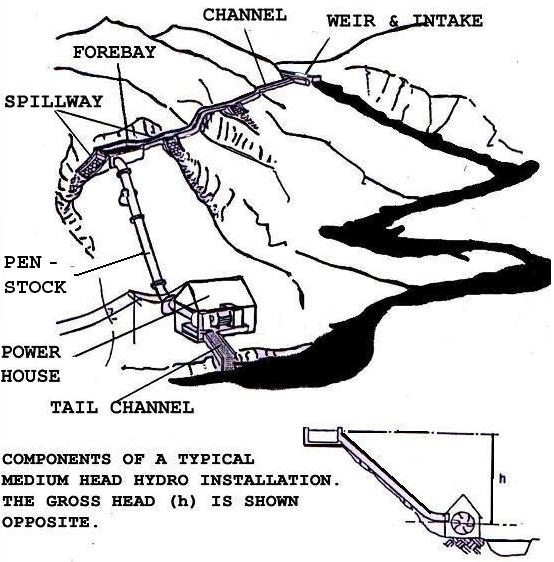 Head Available
The vertical difference in elevation
between the point of tapping of
water and point of installation of
turbine. Units in Meters.
Discharge
The water flow rate through the
turbine. Units in Liters per Second
After flowing through the turbine, the water is lead
back into the stream, hence part of the stream is
diverted and led through the turbine. Pico hydro
projects do not require big dams for storage, hence
called as run-off the river project.
|
|
Head 10 Mtrs
|
Head 20 Mtrs
|
Head 30 Mtrs
|
Head 40 Mtrs
|
Head 50 Mtrs
|
Head 60 Mtrs
|
|
Power |
Discharge |
Discharge |
Discharge |
Discharge |
Discharge |
Discharge |
| 0.5 KW |
10 ltrs/Sec |
5 ltrs/Sec |
3 ltrs/Sec |
3 ltrs/Sec |
2 ltrs/Sec |
2 ltrs/Sec |
| 1 KW |
20 ltrs/Sec |
10 ltrs/Sec |
3 ltrs/Sec |
7 ltrs/Sec |
5 ltrs/Sec |
4 ltrs/Sec |
| 2 KW |
41 ltrs/Sec |
20 ltrs/Sec |
14 ltrs/Sec |
10 ltrs/Sec |
8 ltrs/Sec |
7 ltrs/Sec |
| 2.5 KW |
51 ltrs/Sec |
25 ltrs/Sec |
17 ltrs/Sec |
13 ltrs/Sec |
10 ltrs/Sec |
8 ltrs/Sec |
| 5 KW |
102 ltrs/Sec |
51 ltrs/Sec |
34 ltrs/Sec |
25 ltrs/Sec |
20 ltrs/Sec |
17 ltrs/Sec |
| 7.5 KW |
153 ltrs/Sec |
76 ltrs/Sec |
51 ltrs/Sec |
38 ltrs/Sec |
31 ltrs/Sec |
25 ltrs/Sec |
|
Formulae for calculating power
POWER = ç X 9.81 X Q X H / 1000
Q = LITRES PER SECOND
H = HEAD IN METERS
ç = EFFICIENCY.
POWER = kW
|
EQUIPMENT PACKAGE FEATURES
Turbine
Turbine being offered is of impulse type. Different turbine type is
offered viz., Crossflow and Pelton turbines. By
Studying site parameters and required power output,
We can offer suitable
model that can suit to the site conditions. Turbines
supplied are well engineered and manufactured and
rugged in design
-
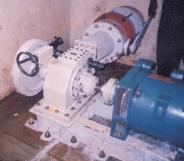
Cross Flow
|
Cross flow turbines are suitable for
medium 'head'. It consists of series of equally spaced
curved vanes welded to circular plates at the edges of
the vanes. These turbines are cheaper and simple in
design. Model being offered: 0.5 kW to 250 kW.
Turbine efficiency is of the order 60-70%.
|
-
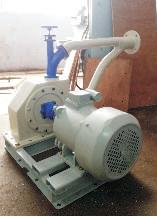
Pelton
|
Pelton turbine classified under impulse type
and particularly suitable for high head with low
discharge. It consists of equally spaced double Semi Ellipsoidal
buckets bolted between a two circular
hubs. These turbines are efficient at different part
load. Model being offered: 0.5 kW to 10 kW. Turbine efficiency is of the order 60-70%.
|
|
-
Generator

|
Till power output of 10 kW standard motor is used as
Generator for power generation . Depending upon output required, like single phase or 3-phase,
BHEL EML make generator will be coupled which is well known to work in high altitudes. Voltage
at the generation point will be standard 240 Volts for
single phase output and 415 Volts for 3phase output.
|
-
Load governor:
Governing is very much essential in all PICO HYDRO
schemes. By doing, system frequency will be kept
constant irrespective of load variation. Load governor
incorporated in the package is of electronic type and
easily mountable on the generator or at a convenient
place. From load governor, cable will be drawn for
power usage at user location.
|
GENERAL PRODUCT FEATURES
-
Portable and rugged.
-
Turbine impeller can be mounted vertically or
horizontally (Option possible only in Pelton
turbine).
-
Turbine shaft can be directly coupled to generator
or belt driven.
-
Capable of running at runaway speed condition.
-
Systems are easy to maintain & spare parts are
inexpensive.
-
Generator can also run at a runaway speed.
Servicing of generator is cheaper and any local
motor winder can carry out service job.
-
Electronic load controller used in the package is
much reliable and proven its working in the filed.
-
Harmonic generated is within acceptable limit,
hence enhancing life of the appliances.
-
System operation is simple and any ordinary labour
can operate the system.
-
Electronic load controller also protects the total
system from any accidental incidents.
-
Electronic load controller also protects from
voltage fluctuations.
-
24 Hours-uninterrupted power supply.
-
Negligible operation and maintenance.
-
Equipment package can also be integrated to
Mechanical loads.
|
USAGE
The power generated can operate any electrical loads.
The typical usage can be.
-
Common home appliances such as incandescent
lamps, tube lights, fans, TVs.
- Other home appliances like Heater, Fridge, Grinder,
Mixer, Iron etc.
- Charging Battery, running UPS system.
- Apart from regular appliances the system can be
customized to energize special applications.
|
ENERGY USAGE AND LOAD MANAGEMENT
Appliances available in the market can be used to meet
the domestic needs on a daily basis. In common tube
lights, mixer, fans TV's etc. Power requirement or usage
is minimum during day and late evening hours. In order
to optimize the power plant's plant load factor, income
generation activities or carrying heating operation in
non lighting hours can be encouraged, this can be
achieved by using low wattage appliances with load
limiter connection. Low wattage appliances provide
end user with higher efficiency without overloading the
generation system. Load limited connection also helps
in supplying better voltage to the end user and also
encourage user in carrying load management at their
level.
|
|